Key Takeaways
- Understanding the division of IPO shares into QIB, NII, and Retail categories is essential for gauging institutional and public sentiment.
- SEBI mandates specific allocation ratios to balance market participation between large institutions and individual investors.
- Retail quotas offer individual investors a reserved portion, while institutional appetite often sets the tone for listing-day price action.
The Mechanics of IPO Allotment
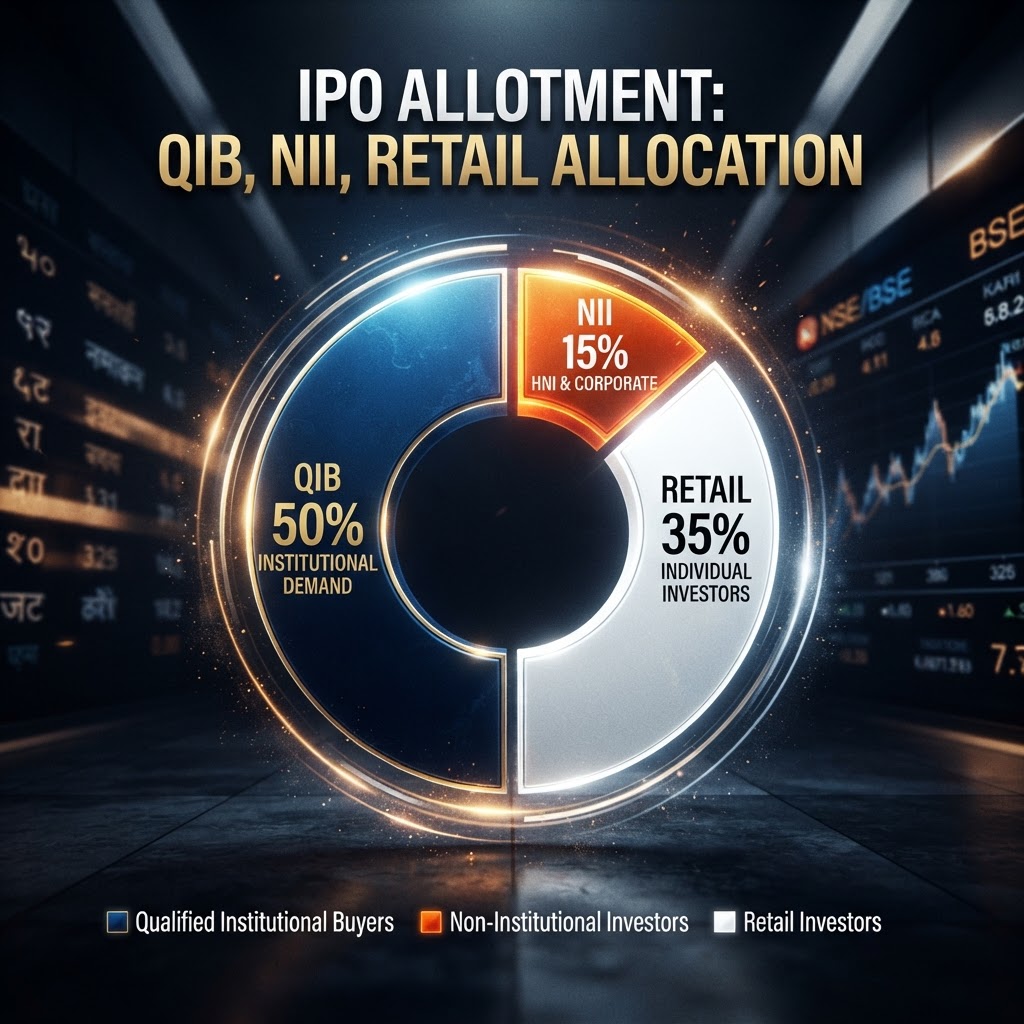
When a company launches an Initial Public Offering (IPO), it does not simply release shares into the market for everyone at once. Instead, the Securities and Exchange Board of India (SEBI) mandates a structured allocation process. Understanding the QIB, NII, and Retail quotas is the first step for any retail investor looking to navigate the primary market with clarity.
These categories are not just administrative hurdles; they serve as a signal of institutional confidence versus retail enthusiasm. By segmenting the investor base, the regulator ensures that large, sophisticated capital cannot crowd out the smaller individual investor completely.
Breaking Down the Investor Categories
Qualified Institutional Buyers (QIBs): These are the "smart money" players. QIBs include commercial banks, mutual funds, venture capital firms, and foreign portfolio investors (FPIs). Because they are presumed to have the expertise to analyze a company’s fundamentals, their subscription levels are often scrutinized by the broader market as a proxy for the issue's long-term quality.
Non-Institutional Investors (NIIs): Also known as High Net-Worth Individuals (HNIs), this category includes resident Indians, Hindu Undivided Families (HUFs), and corporates investing more than ₹2 lakh. While they lack the institutional status of QIBs, their aggressive bidding behavior can lead to oversubscription, often inflating the "grey market" narrative.
Retail Individual Investors (RIIs): This is the segment for individual investors applying for shares worth up to ₹2 lakh. SEBI reserves a significant portion of every IPO for this group to ensure democratic access to wealth creation. Retail participation is often driven by brand familiarity and short-term listing gains, unlike the long-term horizons typically held by institutions.
Why the Quota Mix Matters
Why does the split matter to you? The allocation ratio provides a roadmap of the company’s intent. An IPO with a high proportion of QIB-reserved shares suggests the company is courting long-term institutional stability. Conversely, if a company is seeking higher retail visibility, the distribution may be adjusted to accommodate broader public ownership.
Furthermore, when one category oversubscribes significantly, it creates a spillover effect in terms of market perception. High institutional subscription usually signals that the price discovery process is robust, whereas massive retail oversubscription can sometimes hint at speculative fever rather than fundamental valuation.
Interpreting Subscription Trends
Monitoring the subscription data for each category during the three-day bidding window offers a real-time view of market appetite. Retail investors often make their move on the final day, whereas QIBs may wait until the final hours to place their bids to gauge the overall market demand. Analyzing which bucket fills up first provides context on whether the IPO is being supported by "hot money" looking for a quick exit or "patient capital" looking for a long-term stake.
What to Watch Next
As you evaluate future IPOs, focus on the 'subscription per category' figures released by exchanges. Watch for patterns in how institutional interest aligns with the company’s industry sector and valuation metrics. Relying on the total subscription number alone often masks the true sentiment; looking at the split between QIB, NII, and Retail gives you the complete picture of who is really betting on the stock.
⚠️ Disclaimer: IndiaMarketInsights.com is NOT a SEBI-registered Investment Adviser, Research Analyst, or Investment Advisory firm. This article is published for educational and informational purposes only and does not constitute investment advice, an offer to buy or sell, or a recommendation of any security or financial product. All data and information referenced is sourced from publicly available news and filings. Please consult a SEBI-registered investment advisor before making any investment decision. Past performance is not indicative of future results. Investing in securities involves risk, including possible loss of principal.