Decoding Market Capitalization: Why Large, Mid, and Small Cap Classifications Matter for Your Portfolio
Key Takeaways
- Market capitalization is the total market value of a company's outstanding shares, serving as a primary metric for classification.
- SEBI provides clear guidelines to categorize companies based on their market rank, which helps investors understand risk exposure.
- Large cap stocks typically offer stability, while mid and small caps represent varying degrees of growth potential and volatility.
- Diversification across these segments is a fundamental strategy for managing portfolio risk.
What is Market Capitalization?
At its core, market capitalization, or 'market cap,' is a simple calculation: the current share price of a company multiplied by its total number of outstanding shares. While it sounds like a basic metric, it serves as the foundation for how institutional investors and retail participants segment the Indian stock market. Understanding where a company sits in this hierarchy is the first step in assessing its risk-reward profile.
The Three Tiers: Large, Mid, and Small
In the Indian context, the Securities and Exchange Board of India (SEBI) mandates clear definitions to ensure consistency. Companies are ranked by their market capitalization to determine their classification:
-
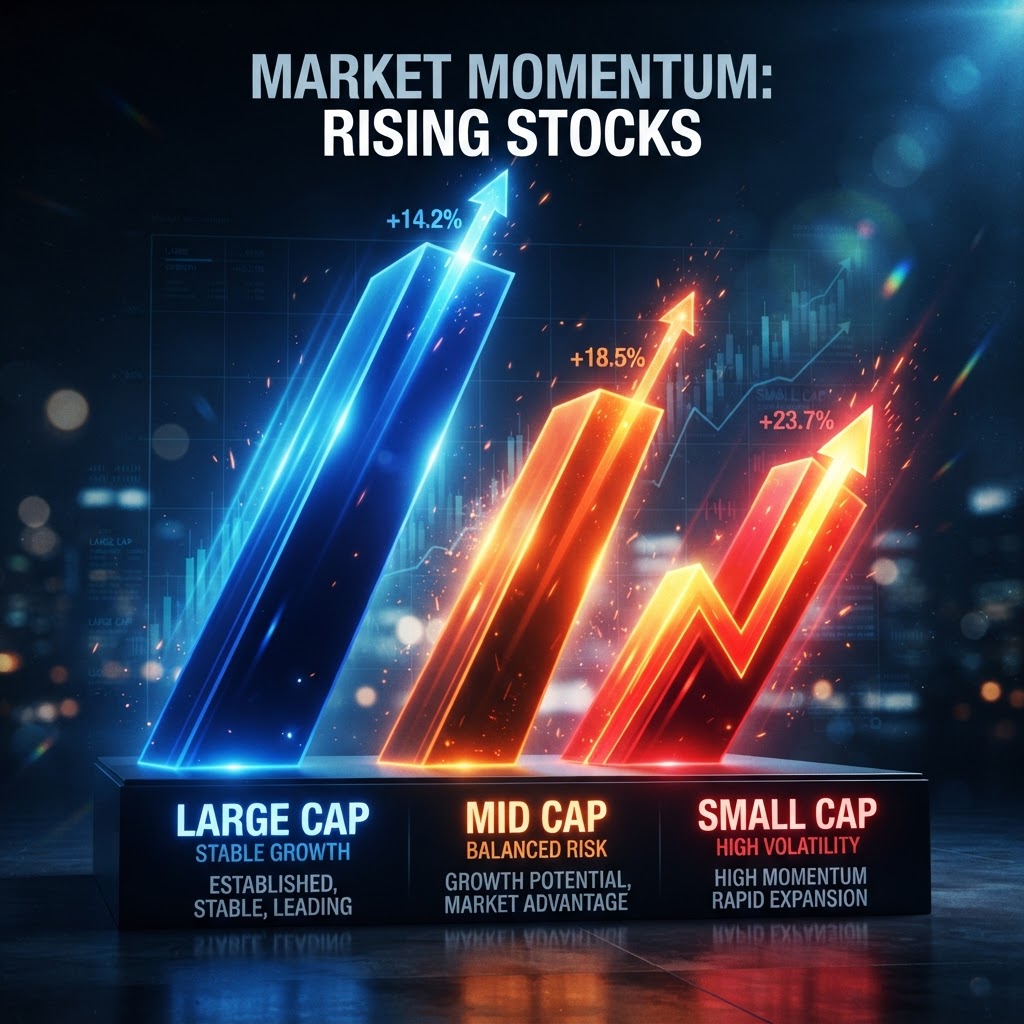
Large Cap: These are the top 100 companies by market capitalization. They are often industry leaders with established track records, strong balance sheets, and higher liquidity. They are typically viewed as the 'anchor' of a portfolio due to their relative resilience during market downturns.
-
Mid Cap: These companies rank from 101 to 250 in terms of market capitalization. They often sit in a sweet spot, having moved past the initial startup risks while maintaining significant room for expansion. They tend to be more volatile than large caps but generally offer higher growth potential over economic cycles.
-
Small Cap: These are companies ranked 251 and beyond. These firms are often in nascent stages or niche sectors. While they carry the highest risk profile—due to sensitivity to economic shocks and liquidity constraints—they also represent the most significant potential for wealth creation if the business model scales successfully.
Why Market Cap Matters for Your Strategy
The importance of these classifications lies in the trade-off between volatility and growth. A portfolio skewed heavily toward small-cap stocks might deliver outsized returns in a bull market, but it could experience significant drawdowns during corrections. Conversely, a portfolio consisting solely of large caps may offer protection but might struggle to beat broader market benchmarks in the long run.
The Bigger Picture: Risk Management
Market capitalization is not just about company size; it is a proxy for risk appetite. When building a portfolio, investors must consider their time horizon and financial goals. A long-term investor with a higher risk appetite might allocate a larger portion of their portfolio to mid and small-cap segments, whereas those nearing retirement may lean toward the stability of large-cap entities. The interplay between these segments is what creates a balanced investment approach, shielding capital while participating in the growth of the broader economy.
What to Watch Next
Investors should monitor their portfolio allocation regularly, as market capitalization rankings can change. As companies grow, they may migrate from small to mid or large-cap categories, potentially altering the risk profile of the stocks held. Staying informed about SEBI’s periodic updates to these rankings is essential for maintaining an aligned investment strategy.
⚠️ Disclaimer: IndiaMarketInsights.com is NOT a SEBI-registered Investment Adviser, Research Analyst, or Investment Advisory firm. This article is published for educational and informational purposes only and does not constitute investment advice, an offer to buy or sell, or a recommendation of any security or financial product. All data and information referenced is sourced from publicly available news and filings. Please consult a SEBI-registered investment advisor before making any investment decision. Past performance is not indicative of future results. Investing in securities involves risk, including possible loss of principal.