Decoding Market Capitalization: Navigating the Risk-Reward Spectrum of Large, Mid, and Small Cap Stocks
Key Takeaways
- Definition: Market capitalization is the total market value of a company's outstanding shares.
- SEBI Framework: The Securities and Exchange Board of India (SEBI) mandates strict categorization based on size to ensure portfolio consistency.
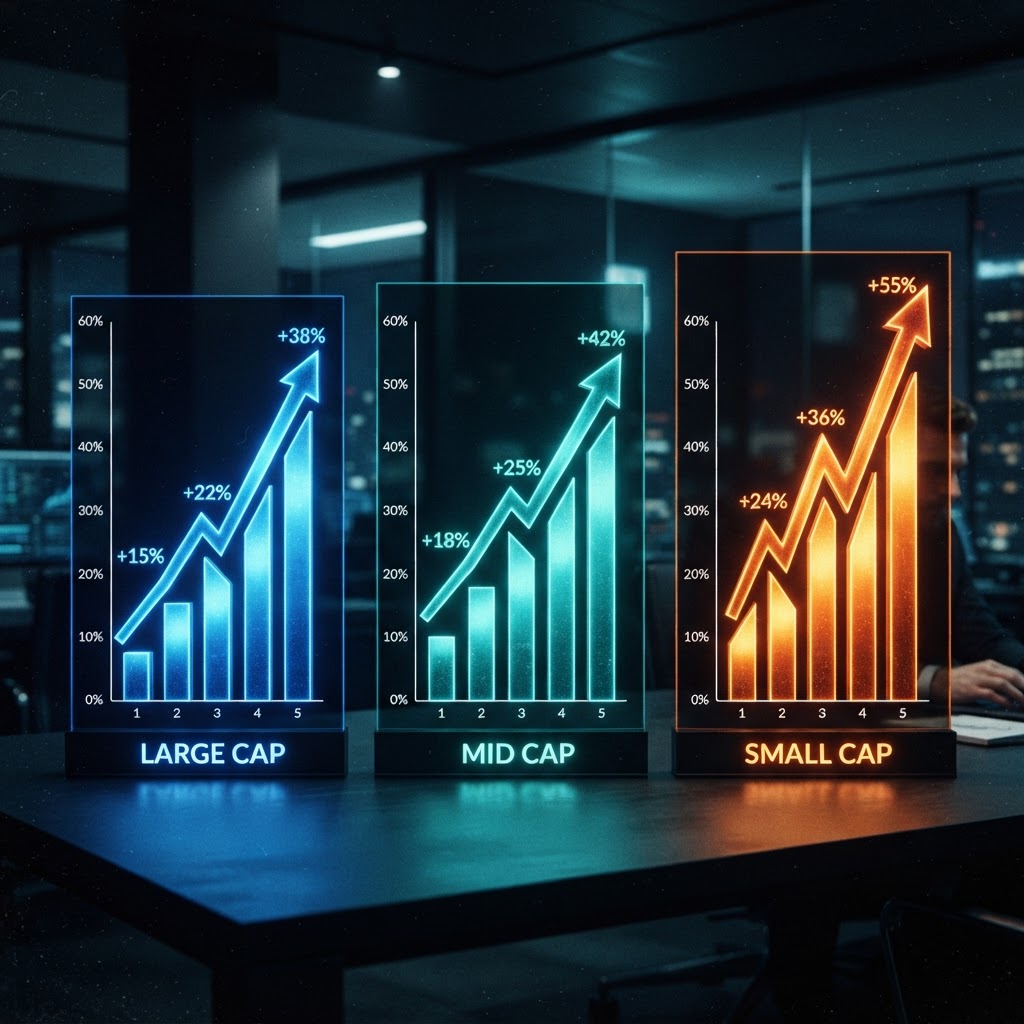
- Risk Profile: Generally, large caps offer stability, while mid and small caps offer higher growth potential alongside elevated volatility.
- Strategic Allocation: Understanding these segments is the first step toward building a balanced investment portfolio.
Defining Market Capitalization
For any investor entering the Indian markets, the term "market capitalization"—or market cap—is fundamental. It represents the total market value of a company’s outstanding equity shares. Calculated by multiplying the current market price of a stock by the total number of outstanding shares, this metric serves as the primary gauge for determining a company's size relative to its peers.
In the Indian context, SEBI provides a clear framework for classifying these companies to help investors navigate market volatility. By dividing listed firms into Large, Mid, and Small Cap categories, regulators ensure that investment products, particularly mutual funds, adhere to specific mandates, preventing style drift.
The Three Tiers Explained
Large Cap Stocks
Large cap stocks are the top 100 companies by market capitalization on the Indian exchanges. These firms are typically industry leaders with established business models, consistent cash flows, and a strong track record of weathering economic cycles. For many investors, they serve as the defensive core of a portfolio, offering lower volatility compared to the broader market.
Mid Cap Stocks
Falling between the 101st and 250th positions in terms of full market capitalization, mid cap companies occupy the "growth" territory. These entities often possess significant expansion potential and may be leaders in niche segments. While they offer higher return potential, they carry more inherent risk than large caps and are more susceptible to liquidity constraints during market corrections.
Small Cap Stocks
Representing the 251st company onwards, small cap stocks represent the most volatile segment of the equity market. These companies are often in the nascent stages of their business lifecycle. While the potential for wealth creation can be substantial, these stocks are prone to sharp price swings, requiring a high risk tolerance and a longer investment horizon.
Why Market Cap Matters for Your Portfolio
Understanding these categories is not merely an academic exercise; it dictates the risk-adjusted returns of your capital. Large caps provide ballast during market downturns, whereas mid and small caps act as engines for capital appreciation during bull cycles.
However, the primary insight for retail investors is the concept of "liquidity risk." As you move down the market cap spectrum, the ease of buying and selling shares without significantly impacting the price often diminishes. This is why financial planners emphasize the role of diversification across these segments rather than concentrating bets in one specific tier.
What to Watch Next
As global and domestic economic conditions shift, the relative performance between these segments often diverges. Investors should monitor macroeconomic data, such as interest rate cycles and corporate earnings growth, which often affect mid and small caps disproportionately compared to their large-cap counterparts. Maintaining a disciplined asset allocation strategy remains the most effective way to navigate the distinct risk profiles inherent in each category.
⚠️ Disclaimer: IndiaMarketInsights.com is NOT a SEBI-registered Investment Adviser, Research Analyst, or Investment Advisory firm. This article is published for educational and informational purposes only and does not constitute investment advice, an offer to buy or sell, or a recommendation of any security or financial product. All data and information referenced is sourced from publicly available news and filings. Please consult a SEBI-registered investment advisor before making any investment decision. Past performance is not indicative of future results. Investing in securities involves risk, including possible loss of principal.