The Hidden Risk of Mutual Fund Overlap: Why Your Portfolio May Be Less Diversified Than You Think
Key Takeaways
- Illusion of Choice: Holding multiple mutual funds often results in redundant holdings, leading to unintended concentration in specific stocks or sectors.
- Correlation Risk: Overlap creates a uniform movement risk; if a few core holdings decline, your entire portfolio suffers simultaneously.
- Active vs. Passive: High overlap is common in index-tracking or large-cap funds; diversification requires intentional selection of varying investment styles.
- The Audit Process: Investors should periodically review their portfolio's common stocks to ensure their asset allocation aligns with their risk tolerance.
The Illusion of Diversification
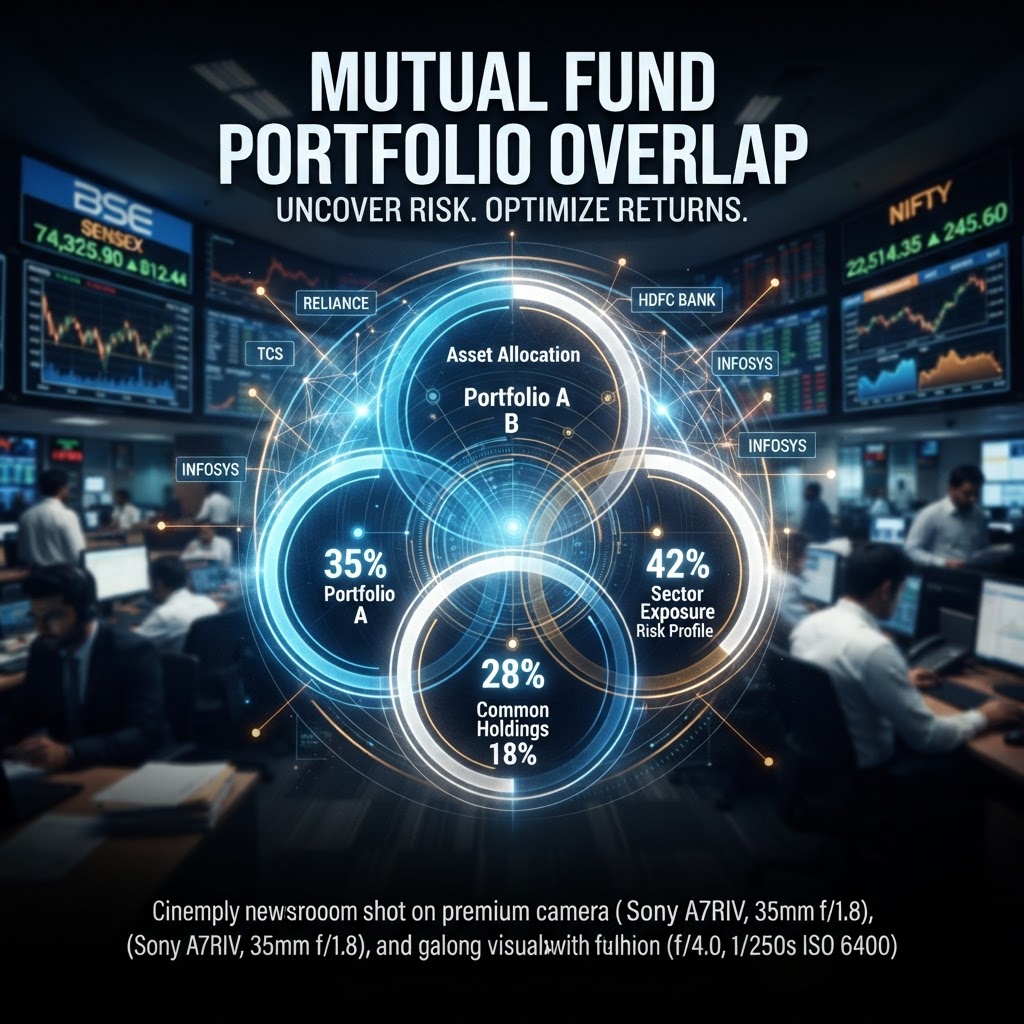
For many Indian retail investors, the default strategy for diversification is simple: buy more funds. The assumption is that by adding another mutual fund to a portfolio, the investor is spreading risk across different baskets. However, this strategy often leads to "mutual fund overlap," a phenomenon where different schemes end up holding identical or highly similar stocks. This overlap can effectively turn a diversified portfolio into a concentrated bet on a handful of blue-chip companies, masking the true level of risk.
Why Overlap Happens
Mutual fund overlap typically occurs when multiple fund managers within the same category—such as Large Cap or Flexi Cap—follow similar investment mandates. Because the universe of high-liquidity, large-cap stocks in India is relatively finite, many funds end up competing for the same set of index heavyweights. If you hold three different large-cap funds, there is a high probability that your top ten underlying stocks are largely identical across all three vehicles. While this provides exposure to high-quality businesses, it fails to provide the idiosyncratic risk mitigation that true diversification is meant to achieve.
The Risks of Concentrated Exposure
When your portfolio is saturated with the same underlying assets, the primary danger is correlation. If a significant percentage of your holdings are concentrated in a single sector or a specific group of companies, your returns become hypersensitive to the performance of those specific stocks. In a market correction, the lack of "unrelated assets" means there is no cushion. Your portfolio will likely drop in lockstep with the market indices, negating the defensive benefits you sought by investing in multiple managers.
Achieving True Portfolio Balance
To move beyond the trap of mutual fund overlap, investors should focus on the composition rather than the number of funds held. Look for "style diversification." Mixing a Large Cap fund with a Mid or Small Cap fund, or incorporating international equity exposure, can help break the correlation chain. Furthermore, check the portfolio disclosure documents provided by fund houses. Comparing the top ten holdings of your funds can reveal if you are unintentionally doubling down on the same market leaders. Diversification is not just about the number of entries in your statement; it is about the distinctiveness of the assets supporting those entries.
What to Watch Next
As the Indian equity market continues to mature, fund managers are increasingly tasked with finding alpha in a crowded field. Investors should monitor whether their fund managers are drifting toward the benchmark or maintaining distinct investment philosophies. A periodic audit of your portfolio—at least annually—remains the best tool for identifying if your investments have become overly homogeneous, allowing you to rebalance toward your original goals.
⚠️ Disclaimer: IndiaMarketInsights.com is NOT a SEBI-registered Investment Adviser, Research Analyst, or Investment Advisory firm. This article is published for educational and informational purposes only and does not constitute investment advice, an offer to buy or sell, or a recommendation of any security or financial product. All data and information referenced is sourced from publicly available news and filings. Please consult a SEBI-registered investment advisor before making any investment decision. Past performance is not indicative of future results. Investing in securities involves risk, including possible loss of principal.